

The Problem With Happiness
Why the pursuit may matter more than the destination

You can also hear AI Matt’s summary of the piece below.
Happiness. It occupies a surprisingly prominent place in our culture.
In the United States, the pursuit of happiness appears right there in the Declaration of Independence, immediately after life and liberty as one of our unalienable rights1. Entire industries have been built around helping people find it. Self-help authors promise it. Politicians invoke it. Therapists discuss it. And if you’re of a certain age, you may remember Will Smith pursuing it in The Pursuit of Happyness.
Even Monty Python got in on the act.
The lead image (and video) for this post comes from their famous Lumberjack Song, where a young man describes his dream of becoming a lumberjack. Not just any lumberjack, mind you. A lumberjack leaping from tree to tree, floating down the mighty rivers of British Columbia, breathing in the smell of freshly cut timber, and crashing mighty trees to the ground. It's an oddly specific aspiration, but no stranger than many of the things people imagine will finally make them happy.
Of course, most of us don’t aspire to become lumberjacks. We have our own versions.
Maybe it’s a promotion. Maybe it’s retirement. Maybe it’s finding the right relationship, buying a house, paying off debt, publishing a book, earning a degree, starting a business, or finally getting around to that project we’ve been putting off for years. The specifics differ, but the underlying logic is often remarkably similar. Happiness sits somewhere in the future, waiting patiently for us to arrive.
And sometimes we do arrive — or so we think.
People get promoted. They retire. They publish the book. They buy the house. They find the relationship. Yet an odd thing often happens once they get there. The satisfaction is real, but it rarely stays put for very long. Before long, attention shifts to the next challenge, the next aspiration, the next thing that still hasn’t been achieved.
And that leads me to a conclusion I’ve reached after many years of following happiness-related research and arguments:
Pursuing happiness as an end state is fundamentally flawed.
And I’m not saying that because I’m horribly cynical (although I can already hear a few people disagreeing). I’m saying it because the more I’ve looked at the research, the less convinced I’ve become that anyone really knows what happiness is, how to obtain it, or how to hold onto it once they've found it. And as it turns out, those are all bigger problems than they first appear2.
Problem #1: We Don’t Actually Know What Happiness Is
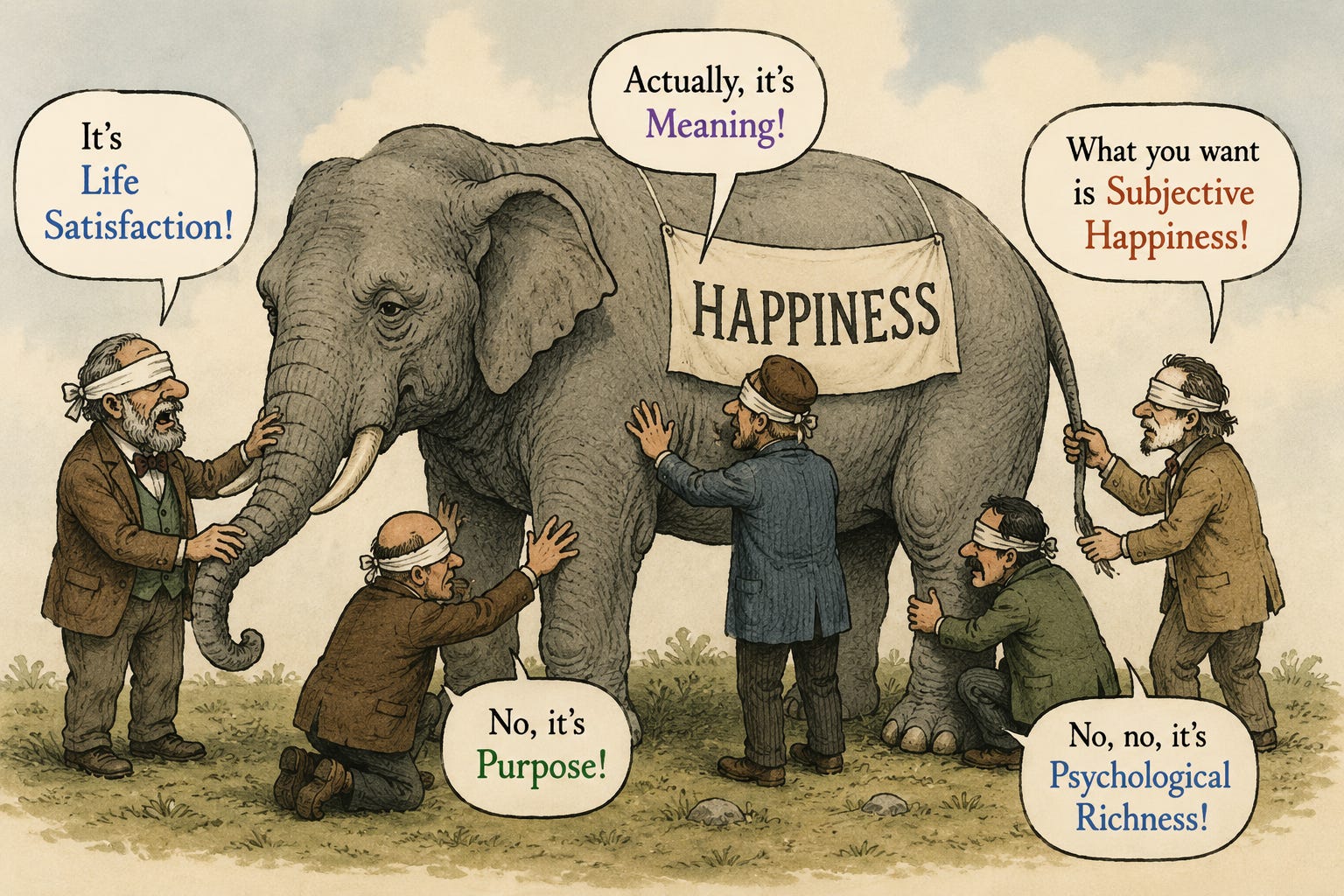
Let’s start with the most obvious problem.
Before we can pursue happiness, it would probably help if we knew what happiness is.
Unfortunately, that turns out to be more difficult than it sounds.
If this post were intended to provide a history of happiness, we could probably start with Aristotle and spend quite a while working our way forward. Fortunately for both of us, that's not where we're going. Even if we fast-forward a couple thousand years and jump directly to modern psychology, the problem remains surprisingly difficult to solve.
To be fair, psychologists have spent decades studying happiness and related concepts. The issue isn't a lack of research. The issue is that researchers don't always mean the same thing when they talk about happiness.
For example, one common distinction separates hedonic and eudaimonic approaches to well-being. While both are often discussed under the broader umbrella of happiness, they begin to look rather different once you examine how they’re actually measured.
Hedonic approaches focus more on pleasure, positive emotions, and satisfaction with one’s life. This is where the work of Ed Diener and others comes in. I mention Diener because he led efforts to develop arguably the most widely used measure of hedonic well-being: the Satisfaction With Life Scale (Diener et al., 1985). The measure is remarkably straightforward. It asks people to evaluate their lives. Are you satisfied with your life? Are the conditions of your life excellent? If you could live your life over again, would you change much?
Eudaimonic approaches, by contrast, focus more on meaning, purpose, growth, and realizing one's potential. This is where Carol Ryff comes in. Ryff (1989) developed a multidimensional measure of psychological well-being that assesses factors such as purpose in life, personal growth, autonomy, and self-acceptance.
Both approaches may be valuable. But they’re certainly not asking the same questions. Someone can be reasonably satisfied with their life while feeling stagnant and lacking a sense of purpose. Conversely, someone can feel deeply engaged in meaningful pursuits while also feeling frustrated, stressed, or dissatisfied with aspects of their current circumstances.
And the situation becomes even more complicated once additional concepts enter the conversation. Meaning. Flourishing. Purpose. Subjective well-being. Psychological richness. Depending on the author, these may be treated as components of happiness, alternatives to happiness, or closely related constructs3.
At this point, you might reasonably object that psychologists have already solved this problem. After all, there are measures that explicitly assess happiness.
And that’s true. Lyubomirsky and Lepper (1999), for example, developed the Subjective Happiness Scale, which asks people to evaluate the extent to which they consider themselves to be happy.
But this doesn’t really solve the problem. After all, if researchers debate what happiness consists of, how do we develop a measure of it in the first place?
The answer, of course, is that we can simply ask people whether they consider themselves to be happy. There’s nothing inherently wrong with doing so. If our goal is to understand how happy people perceive themselves to be, such measures can be quite useful.
The problem is that they tell us very little about what happiness actually consists of.
Imagine three people who all describe themselves as equally happy. We don’t know what it is about their lives that produces that assessment, nor do we know whether the same factors are driving it across all three people.
In that sense, happiness becomes largely subjective and self-defined. That’s perfectly acceptable if our goal is to obtain a snapshot of how happy people believe themselves to be. It becomes much less useful if our goal is to understand how happiness is created, maintained, or increased.
And that’s really the problem.
The advice to “pursue happiness” sounds straightforward until you start asking what happiness actually means. At that point, the destination becomes surprisingly difficult to identify. Depending on who you ask, happiness may refer to satisfaction, positive emotions, meaning, purpose, flourishing, psychological richness, or some combination of the above.
The point isn’t that any of these perspectives are wrong. The point is that they point toward different destinations. Before we can pursue happiness, it would probably help to know which destination we’re trying to reach.
Unfortunately, even if we could solve that problem, we’d immediately run into another one. And that leads us to Problem #2.
Problem #2: We’re Not Very Good at Predicting What Will Make Us Happy
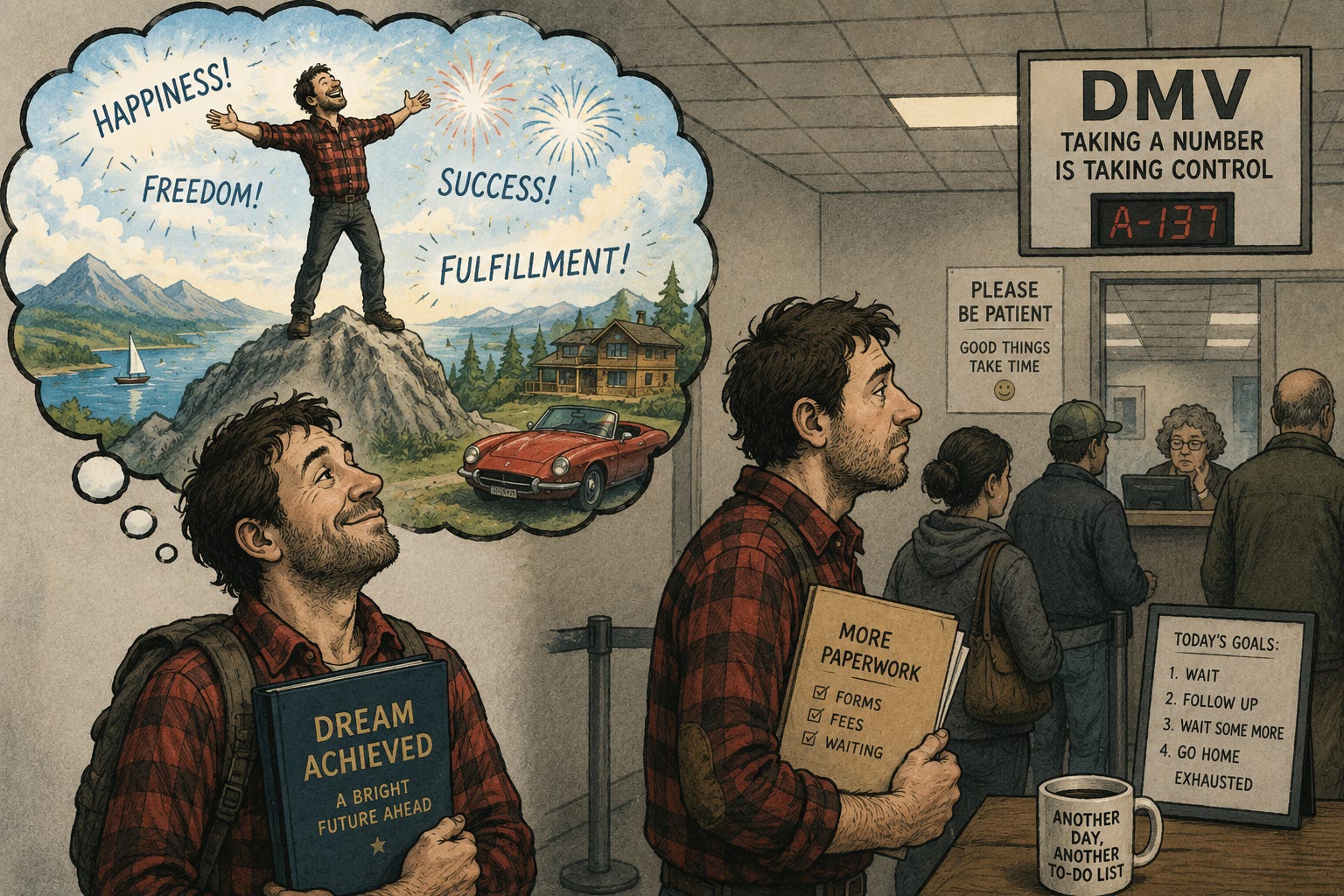
Suppose, for the sake of argument, that we’ve somehow solved Problem #1.
Let’s assume that you’ve arrived at a definition of happiness that you’re comfortable with. Maybe happiness means satisfaction. Maybe it means meaning and purpose. Maybe it means some combination of the two. Whatever the case, let’s assume you know exactly what you’re trying to pursue.
Unfortunately, that doesn’t solve the problem.
Because humans aren’t especially good at predicting what will make them happy.
This is where the work of psychologist Dan Gilbert becomes relevant. In his book Stumbling on Happiness, Gilbert argued that people are surprisingly poor at forecasting the preferences and reactions of their future selves. We imagine how happy, unhappy, satisfied, or disappointed we’ll feel if certain events occur, but those predictions are often wrong.
Sometimes we overestimate how much a positive outcome will improve our lives. Sometimes we overestimate how devastating a negative outcome will be. And sometimes we simply pursue things that seem as though they should make us happy only to discover that they don’t produce the experience we expected.
We convince ourselves that a promotion will finally make work enjoyable, only to discover that it mostly came with more responsibility and meetings. We imagine retirement as an endless vacation, only to find ourselves searching for structure and purpose. We assume that moving, changing jobs, or making a major purchase will fundamentally change how we feel, only to discover that the effect is smaller or shorter-lived than we anticipated.
Part of the problem is that happiness is a moving target. Part of it is that we adapt to changing circumstances. Part of it is that our future selves don’t always want the same things our present selves think they will.
Whatever the reason, the practical implication is difficult to ignore. Even if we know what happiness means, that doesn’t necessarily mean we know how to obtain it.
And yet there is an even more frustrating possibility.
Sometimes people correctly identify something that improves their happiness. They get the job. They find the relationship. They achieve the goal. They obtain exactly what they were seeking.
So, now it seems like those people have solved the problem. They figured out what happiness means. They correctly identified something that would make them happy. They achieved it. Good for them. Right?
Well, all that really does is introduce Problem #3.
Problem #3: Happiness Has a Short Shelf Life

Let’s return to the people who managed to solve Problems #1 and #2.
They figured out what happiness meant to them. They correctly identified something that would make them happy. And they achieved it.
Now what?
Do they spend the rest of their lives basking in a permanent state of happiness and contentment?
Not hardly.
What they’re more likely to experience is a period of satisfaction. They achieved something they cared about. They reached a goal. They obtained something they wanted. And yes, they may experience a genuine increase in happiness.
The problem is that the feeling rarely lasts forever.
Over time, people tend to become accustomed to their new circumstances. What once felt exciting becomes familiar. What once felt extraordinary becomes normal. Psychologists often refer to this tendency as hedonic adaptation (Lucas, 2007), or more colloquially, the hedonic treadmill. We experience positive changes, but eventually return toward a relatively stable baseline level of well-being.
Perhaps the easiest way to think about this is to use an analogy. Imagine someone receives a substantial raise or lands their first high-paying job. Initially, the increase in income may feel transformative. Suddenly there’s more money available for travel, entertainment, hobbies, housing, or any number of other things. Yet over time, something interesting often happens. Spending habits adjust. Expectations change. What once felt like abundance gradually becomes the baseline against which future circumstances are judged.
Something similar often happens with the things that initially make us happy. The promotion eventually becomes your job. The new house becomes your home. The degree becomes a line on your résumé. The achievement remains real, but it no longer occupies the same psychological space it once did. What was once a destination gradually becomes part of everyday life.
At first glance, this sounds like a flaw in the system. Why would we be built in a way that prevents us from remaining satisfied with things we worked so hard to obtain?
According to Pinsof (2026), the answer may be that this isn't a flaw at all. His argument is that many of our desires are effectively “antisatisfiable.” Satisfying them doesn’t eliminate them. Instead, it simply changes the standard against which future circumstances are evaluated. New desires emerge. Expectations shift. Comparisons change. The goalposts move.
A person who receives a promotion may begin thinking about the next promotion. A person who achieves financial security may begin worrying about preserving it. A person who develops expertise in a domain may begin noticing new areas where they still fall short. The original goal may have been achieved, but achieving it often creates new goals in the process.
When you think about it, the tendency for satisfaction to fade starts to make a certain amount of sense. A person who became permanently satisfied after achieving a goal would have little reason to continue striving. There would be no need to improve, compete, explore, create, learn, or adapt. The motivational system would effectively shut itself off.
Whether or not Pinsof’s explanation is completely correct, it highlights something important. The psychological mechanisms that make lasting satisfaction difficult may be the very same mechanisms that keep us moving forward.
And that raises an interesting possibility.
Perhaps the issue isn’t simply that satisfaction fades. Perhaps satisfaction and motivation are serving different functions altogether.
That possibility becomes especially interesting when we consider research on motivation and engagement. Warr and Inceoglu (2012), for example, argued that motivation is often fueled by discrepancies between one’s current state and a desired future state. In simple terms, part of what motivates us is the existence of a gap between where we are and where we would like to be.
Based on this perspective, satisfaction and engagement serve different purposes, even though they’re often lumped together under the broader category of positive well-being. Engagement creates movement. It reflects the pursuit of a desired future state. Satisfaction is what we feel when we get there.
But the process doesn't stop there. Once we achieve the goal, the satisfaction we experience is often temporary. Expectations adjust, and new goals emerge. What was once a source of satisfaction gradually becomes part of the baseline, and the cycle begins again.
Rethinking the Pursuit of Happiness
And that brings me back to the pursuit of happiness itself.
If satisfaction is temporary by design, and engagement depends on the existence of goals that have not yet been achieved, then the idea of reaching a permanent state of happiness starts to look increasingly unrealistic. The destination keeps moving because movement may be part of how the system works.
Perhaps that’s also part of the reason we’re not very good at predicting what will make us happy. What we’re missing today often becomes tomorrow’s baseline. The thing we believe will finally satisfy us may very well do so — but only temporarily. Once achieved, it gradually becomes part of the status quo, and our future selves begin looking toward new goals, new challenges, and new aspirations.
In that sense, the three problems I discussed are all pointing toward a similar conclusion. Happiness, as an end state, may not really exist. It’s not a destination we eventually arrive at or a goal we permanently achieve. That’s why we struggle to define it. That’s why we’re not very good at predicting what will finally get us there. And that’s why the pursuit of happiness often seems never-ending.
Whether intentionally or not, Thomas Jefferson may have been onto something when chose the language he did for the Declaration of Independence. When he wrote that people possess the right to life, liberty, and the pursuit of happiness, he didn't identify happiness itself as an inalienable right. He identified the pursuit of happiness as one.
And that brings me back to our aspiring lumberjack.
The funny thing about the Lumberjack Song is that we never really learn much about what it would actually be like to be a lumberjack. What we get instead is an idealized vision of the future. Leaping from tree to tree. Floating down the mighty rivers of British Columbia. Breathing in the smell of freshly cut timber. The dream is vivid. The reality remains largely unexplored.
Maybe that’s true of happiness too.
We become remarkably good at imagining how satisfying a future achievement will be. We picture the promotion, the retirement, the relationship, the house, the degree, or the book. We imagine how we'll feel when we finally get there. What we rarely imagine is what happens next.
But perhaps the arrival was never really the end of the story. Sooner or later, the goalposts move. A new challenge appears. A new aspiration emerges. And off we go again, leaping from tree to tree along the mighty rivers of British Columbia.
I hadn’t planned on publishing this one this week, but with the Fourth of July marking the 250th anniversary of the Declaration of Independence, a post that referenced it seemed apropos. That just means you’ll have to wait another few weeks to be introduced to Canadian military raccoons.
If you've already solved all three problems, there may be a place for your solution in the multibillion-dollar happiness industry. Based on the number of books, seminars, podcasts, retreats, courses, and influencers currently devoted to the topic, competition appears to be fierce.
So I’m clear, these constructs aren’t completely independent of one another. Measures of life satisfaction, meaning, purpose, psychological well-being, flourishing, and related concepts are often moderately to strongly correlated. The extent of that overlap varies from construct to construct and study to study. The point here is not that these concepts are unrelated. The point is that researchers continue to debate where one ends and another begins, which complicates efforts to define exactly what we mean by "happiness."
Matt, my compliments on this piece. I haven't done the research you have, but to me this conclusion seems both uncontroversial and inevitable.
I didn't inherit the cultural legacy of 'the right to pursue happiness' and have never believed it. If a right is a social affordance requiring others to sacrifice their convenience then this means either too much or nothing at all.
Too much: my desire to be self-satisfied can inconvenience you as much as I want, while never suffering meaningful censure;
Nothing at all: my 'right' is actually a permission that has never required your consent.
What I think was intended: the founders were trying to explain the difference between citizen and subject. Subjects do as they're told and are told that failing to be happy about it is sedition. Citizens do as they please within the law and are to be celebrated and accommodated in their diversity of aims to the extent that the fabric of society itself can accommodate them.
I think it's a massively overstated aspiration, perhaps because there were so few clear examples of how to run it.
A shifting context matters here too. The framers were largely Deists -- people who believed in a morally-ordered world where physical and moral consequences would prove to eventually align. But the last Deist of any stature was Einstein. His plaintive denial 'God does not play dice with man' was Deism's epitaph, lacking only an 'Oh, crap' at the end.
What I would offer instead:
Define respect as to embrace the inconvenience of good on another's terms. Define dignity as recognition of the good that's worth the inconvenience.
I think the framers were panning for 'respect' and 'dignity' and got the Fools Gold of 'equality' and 'pursuit of happiness' instead. One is outright false, the other naive.
I also don't think it mattered too much until it hit an economy built on industrialising consumer sales to atomised individualism -- the Boomers were the first generation to show how badly that fared, but not the last.
I also think this is not just a psychological issue but a cultural one. It acutely needs reform.
I feel like I have had a good life, and I am reaching the end. Happiness was my goal all along the way, and I have mostly achieved it.
Sartre said we are “condemned to be free”. We need to welcome this tremendous responsibility as a first step to happiness. We also need to realise that life will have both ups and downs. There will be times when you are not happy, but it's up to you to move on and find the next happiness.
I have brain cancer now, and I will be leaving you in the not-too-distant future, but I have had a great time while I was here. I sailed the seas in the Royal Navy. I backpacked around the world. I've lived in four countries and 15 cities, including London, New York, Valletta, San Jose, Glasgow & Palo Alto. I have a wife and two kids. Now I am back in Bristol, reading my books and watching the boats go by.
Accepting that there will be downs as well as ups is the secret to happiness. And we all face the biggest down of all, but even that will pass. Enjoy the happiness while you can.
Epicurus had something to say about this.
"We must, therefore, pursue the things that make for happiness, seeing that when happiness is present, we have everything; but when it is absent, we do everything to possess it."
We have to find our own meaning of happiness without worrying about what the philosophers say. You'll know happiness when you find it.